
Faster Evacuation Times Drive Higher Output in Thermoform Packaging
VCS301+ Performance Advantages for Cycle-Time-Critical Applications
Executive Summary
In cycle-time-critical thermoform packaging applications, evacuation performance has a direct impact on throughput and cost per package. Faster evacuation to the defined process vacuum allows packaging machines to complete more cycles per minute, improving line utilisation without mechanical modifications. Recent performance evaluations show that the VCS301+ oil-lubricated rotary vane vacuum pump reaches process vacuum earlier than market-average designs, enabling measurable cycle time and productivity gains in real packaging operations.
Why Evacuation Time Matters in Thermoform Packaging
In thermoform food packaging, every production cycle requires the forming and sealing chambers to be evacuated to a defined process vacuum, typically around 5 mbar absolute, before sealing can begin. The evacuation phase represents a significant share of the total cycle time and is repeated continuously during operation.
As cycle times become increasingly tight, even small improvements in evacuation dynamics can translate into higher throughput, improved asset utilisation, and lower cost per packaged unit. The decisive factor is not nominal pumping speed alone, but how quickly the vacuum system reaches the required process vacuum under real operating conditions.
Evaluating Real Evacuation Performance
Traditional pump comparisons often focus on nominal pumping speed values. In packaging applications, however, the relevant performance indicator is the complete evacuation behaviour from atmospheric pressure down to the process vacuum level.
For this reason, performance assessments for thermoform packaging should focus on:
- The full evacuation curve under representative operating conditions
- The point at which the defined process vacuum is reached
- Effective pumping speed across the relevant pressure range
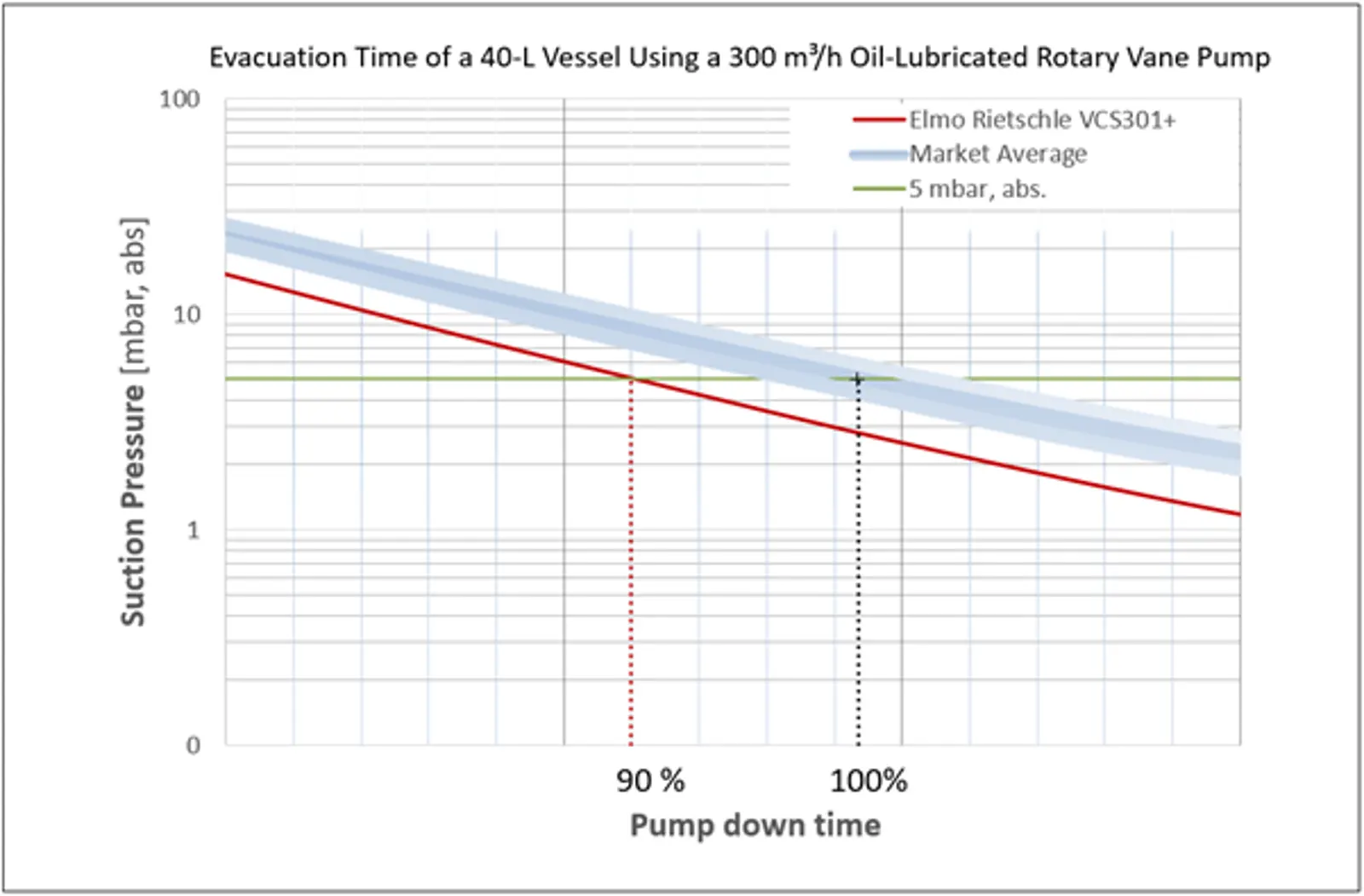
When evaluated using this approach, clear differences between pump designs become visible. Market-average oil-lubricated rotary vane pumps typically reach the process vacuum at a normalised cumulative evacuation effort of around 100%, with some designs requiring even more.
Expert insight
“In thermoform packaging, nominal pumping speed alone doesn’t define performance. What matters is how quickly the vacuum system reaches the required process vacuum within each cycle. Earlier completion of the evacuation phase directly increases achievable throughput.”
— Mihail Chirilovici, Engineering Manager
The VCS301+ reaches the same process vacuum at approximately 90% cumulative evacuation effort, representing an improvement of around 10% compared to the market average. This earlier completion of the evacuation phase directly contributes to shorter effective cycle times.
Impact on Cycle Time and Packaging Throughput
Because evacuation is required during every packaging cycle, improved pumpdown dynamics directly affect achievable throughput. Reaching the process vacuum sooner either shortens the overall cycle time or increases the available process margin within the same cycle time.
In practical thermoform packaging applications, the improved evacuation behaviour of the VCS301+ can enable at least one additional packaging cycle per minute, without changes to the packaging machine’s mechanical or control systems. Over extended operating periods, even this small increase results in a substantial rise in total output per line.
Translating Faster Evacuation into Economic Value
The economic benefit of faster evacuation becomes clear when throughput gains are translated into production output and profitability.
Example: Throughput-Driven Profit Increase
Assumptions (illustrative and conservative):
- 1 additional tray produced per minute
- Profit per tray: €1
- Continuous operation: 24 hours per day
Result:
- Additional output: 1,440 trays per day
- Additional profit: €1,440 per day
- Additional profit: €7,200 per week per production line
This value is generated purely through improved evacuation performance, without additional labour, energy-intensive process changes, or new machinery investments.


Engineering Basis of the VCS301+ Evacuation Advantage
The evacuation performance of the VCS301+ is not achieved through higher nominal pumping speed alone. Instead, it results from targeted design optimisations that increase effective pumping performance across the pressure range most relevant for packaging processes.
Key design contributors include optimised volumetric efficiency, enhanced internal gas flow paths, and stable dynamic pumping behaviour throughout the evacuation process. These features ensure that high effective pumping capacity is available precisely where fast pumpdown has the greatest impact on cycle time.
Conclusion
In thermoform food packaging, evacuation performance is a decisive lever for productivity and economic efficiency. Reaching the required process vacuum earlier within each cycle enables higher throughput, improved utilisation of installed equipment, and reduced cost per packaged unit.
By achieving the process vacuum at a significantly reduced cumulative evacuation effort, the VCS301+ oil-lubricated rotary vane vacuum pump sets a new benchmark for evacuation performance in cycle-time-critical packaging applications. For manufacturers operating under tight cycle constraints, faster evacuation provides a technically robust and immediately effective path to higher output and improved profitability.